How Do I Hire An App Developer That Works With AI Efficiently?
Finding the right talent to bring your app vision to life can make or break your business in today's competitive digital market. When you hire app developer professionals who understand both traditional coding and emerging AI technologies, you're investing in someone who can transform ideas into intelligent, user-friendly applications. The key lies in identifying experts who can efficiently build AI-powered solutions while ensuring faster development cycles and successful project outcomes that align with business goals.
Accelerating the development process while maintaining quality requires more than just skilled developers. Smart teams integrate AI-driven tools that handle repetitive coding tasks, reduce errors, and streamline workflows. Whether working with freelancers, in-house teams, or development agencies, the right combination of talent and technology delivers faster time-to-market and more adaptive solutions that respond to user needs. Discover how Orchids's AI app generator can complement your hiring strategy and empower your development team.
Table of Contents
- Why We Still Need Developers in the AI Age
- How to Maximize ROI When Hiring an App Developer
- Step-by-Step Path to Hiring a Developer You Can Trust
- Build Your First App Fast with AI and See What a Developer Can Do
Summary
- AI tools increase developer productivity by 67% according to the State of Web Dev AI Survey 2025, but that boost comes from automating boilerplate code and routine tasks, not strategic decision-making. A 10-screen e-commerce app still requires 200 to 300 hours because AI cannot determine whether single sign-on serves users better than traditional login, how to structure databases for future scale, or what happens when payment processing fails at 2 AM. AI handles roughly 40 to 60 percent of boilerplate tasks while developers focus on architecture, business logic, and problem-solving that defines whether applications actually solve business problems.
- Companies achieve up to 70% savings by aligning development work directly to business outcomes rather than feature parity, according to Simera. Teams waste budget building features nobody needs when they skip defining concrete success metrics like mobile traffic numbers, conversion rates, or revenue thresholds. Filtering every proposed capability through whether it directly contributes to conversions, retention, or monetization eliminates scope creep disguised as user value and reduces expensive rework cycles.
- The average time to hire a software developer is 42 days, according to LinkedIn Talent Solutions, with most of that time spent on back-and-forth clarification because teams skip upfront definition work. Vague specifications like "a social app with messaging" describe a thousand different products and force developers to quote conservatively to cover unknowns. Geographic location significantly impacts costs, with Indian developers averaging $2,349 per month, Philippine developers $1,711, and US-based talent $10,784, but timezone overlap and communication norms matter as much as hourly rates.
- Only 12% of developers believe AI will replace their jobs within five years, according to the State of Web Dev AI Survey 2025, reflecting daily experience with AI's limitations. AI-generated code requires review for efficiency, maintainability, and security because it might introduce subtle bugs, follow outdated patterns, or miss critical edge cases that become exponentially more expensive to fix in production. The code AI produces serves as a starting point while developers ensure proper system integration, graceful error handling, and reliable performance under load.
- Seventy percent of startups fail due to premature scaling, according to Reenbit, often because they hire too expensively too early or compromise on quality to save costs. Payment structures should reward progress rather than promises by splitting compensation across milestones tied to specific deliverables, such as "completion of user authentication module with OAuth integration," rather than elapsed time. Building in a 30-day post-launch support window protects both parties by addressing bugs and performance issues that only surface under real user load.
- AI app generator from Orchids lets developers build across any stack through conversational interfaces, handling boilerplate implementation while developers focus on architecture, integration decisions, and whether solutions align with business priorities under realistic load conditions.
Why We Still Need Developers in the AI Age
AI tools can create working code and automate repetitive tasks, but they cannot replace the strategic thinking, architectural decisions, and business judgment that experienced developers bring to complex projects. Developers will evolve to guide AI outputs toward production-ready solutions.
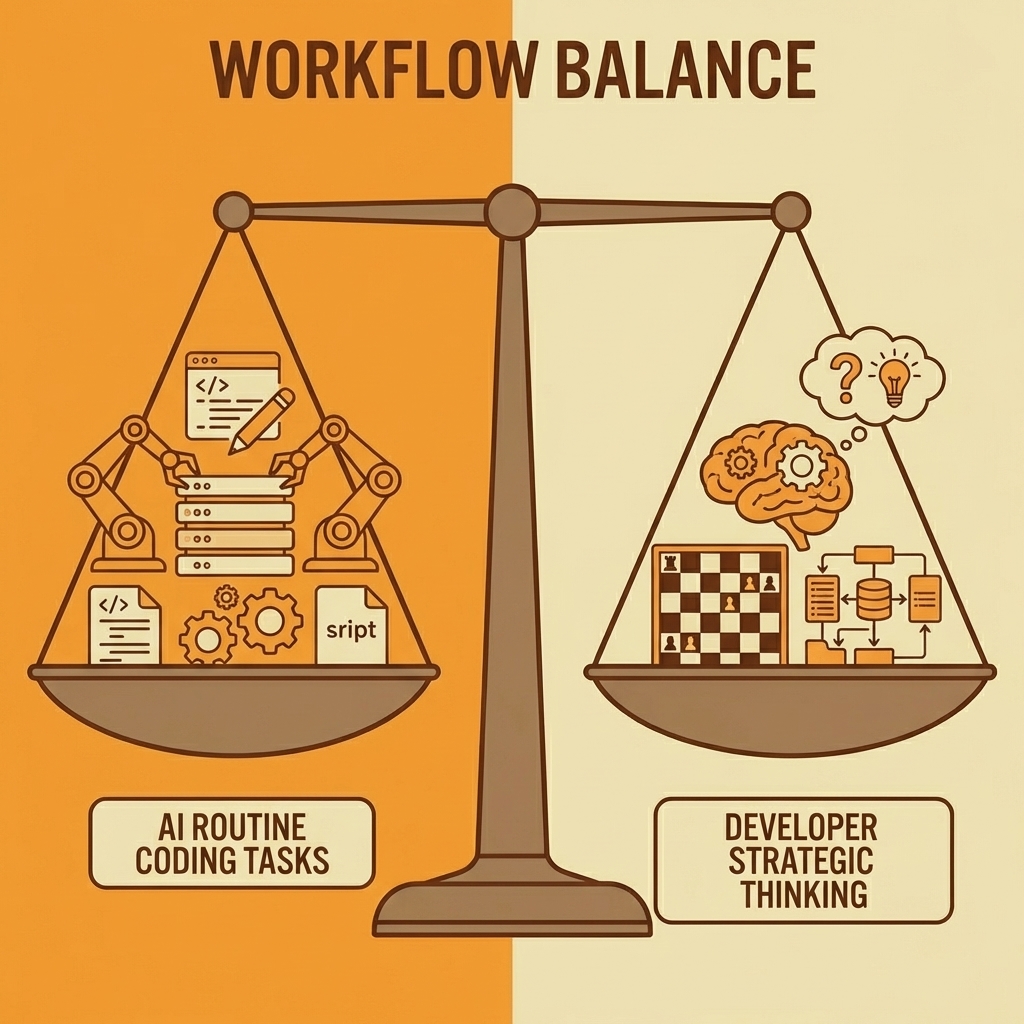
Key Point: While AI excels at routine coding tasks, it lacks the contextual understanding and domain expertise needed to make critical architectural choices that determine project success.
"AI can write code, but it cannot understand the business context, technical constraints, and long-term implications that drive architectural decisions in real-world applications." — Software Engineering Research, 2024
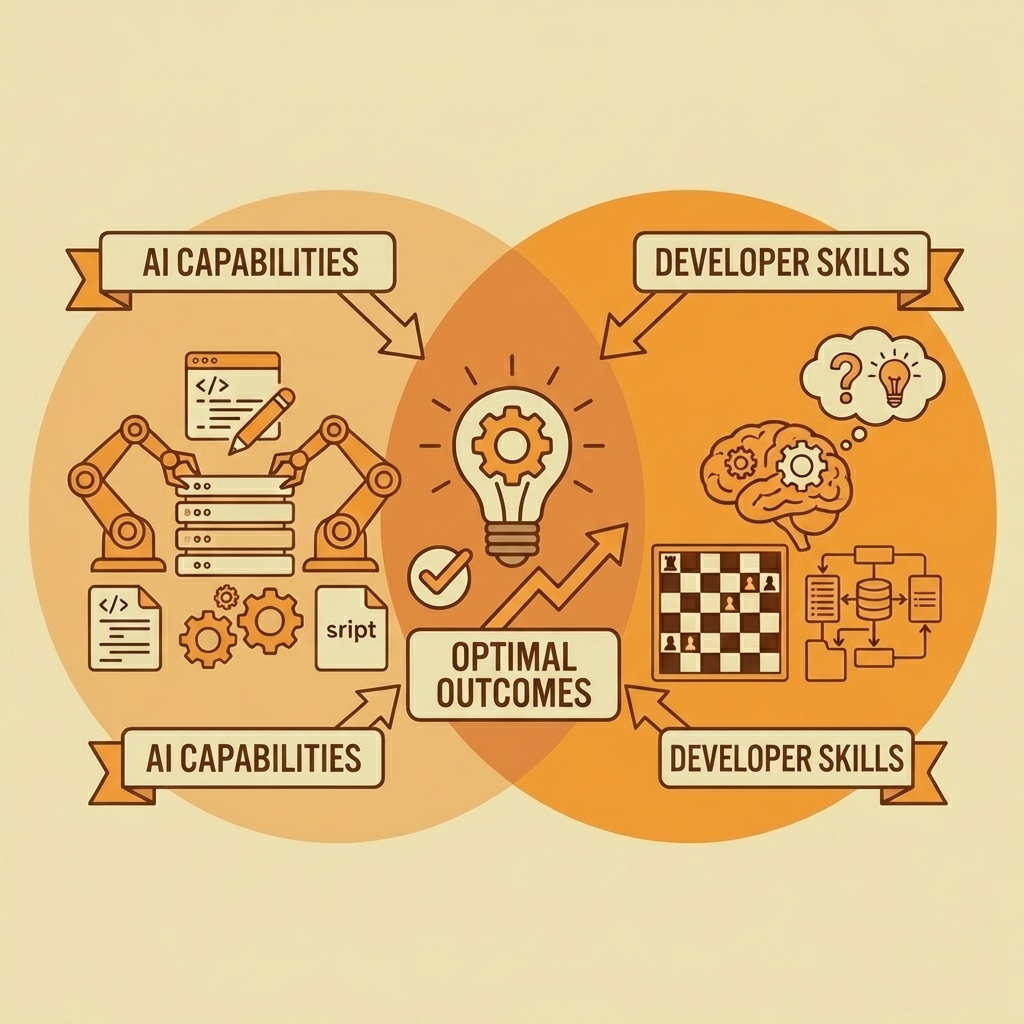
Tip: The future belongs to developers who can leverage AI as a powerful assistant while maintaining their strategic oversight and problem-solving expertise for complex, high-stakes decisions.
AI Handles Tasks, Not Problems
According to the State of Web Dev AI Survey 2025, 67% of developers say AI tools help them work faster. AI excels at automating repetitive coding tasks, suggesting bug fixes, optimising functions, and performing pattern recognition within clear limits. It can create a login form, rebuild a component, or suggest performance improvements based on existing code patterns.
Why can't AI solve complex problems?
What AI cannot do is understand why you need that login form. It doesn't question whether single sign-on would better serve your users or whether your authentication strategy aligns with your data privacy requirements.
A 10-screen e-commerce app might take 200 to 300 hours to design and build properly, even with AI handling routine coding. That time goes into decisions AI cannot make: structuring your database for future growth, choosing third-party services, handling edge cases in checkout flow, and managing payment processing failures.
The Architecture Gap
AI-assisted coding tools handle roughly 40 to 60 percent of boilerplate tasks but struggle with architecture, logic, and problem-solving. Without senior developer oversight, code often compiles and runs but lacks the structural integrity needed for real-world use.
Consider a checkout optimization: AI might suggest faster load times, but a developer understands that slightly slower performance could be acceptable if it enables personalized recommendations that increase order value. AI sees code performance; developers see user behaviour, business metrics, and competitive positioning. This gap between functional code and strategic value is where experienced developers remain essential.
Developers as AI Guides
The role is shifting from writing code to managing AI tools. Developers who excel know how to explain problems to AI, verify results, and integrate them into functional systems. They ask questions AI cannot answer: Does this create technical debt? How will this work with 10 times more traffic? What security risks does this approach introduce?
What does AI-powered development amplification look like in practice?
Tools like Orchids demonstrate this shift. Rather than replacing developers, AI-powered environments amplify their capabilities by handling repetitive tasks, freeing them to focus on architecture, integration, and business logic. Our platform works across any language and framework, allowing teams to maintain existing workflows while AI accelerates implementation. Fortune 500 companies use Orchids to help existing teams build more advanced applications faster.
The Trust Problem
The State of Web Dev AI Survey 2025 found that only 12% of developers believe AI will replace their jobs within five years. AI-generated code requires review for functionality, maintainability, and security. It may introduce subtle bugs, rely on outdated patterns, or miss important edge cases. Teams deploying AI code without developer review often discover these issues in production, where fixes cost significantly more.
What problems do developers catch in AI code?
Developers ensure AI-generated code integrates with existing systems, adheres to team standards, handles errors gracefully, and performs reliably under heavy load. They identify security vulnerabilities in authentication modules, recognise database queries that fail under high-volume data, and spot API integrations that break when third-party services change their response formats.
Why Demand Is Growing, Not Shrinking
AI doesn't reduce the need for developers; it expands what's possible to build. Companies can prototype faster, test more ideas, and scale development efforts more efficiently. Businesses need developers who can design systems that leverage AI capabilities, integrate AI-generated components into production environments, and make architectural decisions that AI cannot.
Using AI effectively requires the same depth of experience that makes developers valuable.
Related Reading
How to Maximize ROI When Hiring an App Developer
Define what success looks like before development begins. Too many apps launch with unclear goals around awareness or engagement, then spend budget chasing features that don't convert users or drive revenue. Set concrete targets upfront: mobile traffic numbers, newsletter subscriptions, ecommerce conversion rates, and affiliate revenue thresholds. Whatever metric proves the app delivered business value, not technical functionality.

How do you avoid scope creep when building features?
The failure point is usually scope creep disguised as user value. Teams see competitors shipping features and assume they need the same capabilities. However, according to Simera, companies can achieve up to 70% savings by aligning development work directly to business outcomes rather than feature parity.
Filter every proposed capability through a single question: Does this directly contribute to our defined success metrics? If a feature doesn't help with conversions, retention, or monetisation, it's a waste regardless of how impressive it looks in a demo.
Why do user personas improve app performance?
When personas closely match real people, apps connect immediately because they feel tailored to that person. Create detailed profiles that outline age groups, interests, goals, problems, and technical skills for each user group.
Design the app's flow to solve what matters most to users and address their concerns directly. Base features on what users need, not assumptions. This reduces rework, helps the product find its market faster, and increases conversion rates from users who see that the app was built for them.
How do you balance speed with quality when shipping products?
Don't pack every feature into your first release. Instead, focus on a minimum viable product with a narrow but high-value set of features that will help you reach your success goals.
Release your product quickly to gather real user feedback and confirm it meets genuine needs. Staying lean enables frequent experiments, letting you learn what drives results before investing in extra features.
Why should teams move beyond quarterly release cycles?
Most teams rely on quarterly updates because deployment feels risky. As traffic grows and user expectations change, those large infrequent code dumps increase risk rather than reduce it.
The architect designed continuous delivery pipelines that enable weekly or daily deployment of new app versions without disruption. This accelerates learning from user data to improve retention and satisfaction, while allowing flexibility to react to market changes.
The return on investment shows up in reduced time-to-value for improvements and lower cost per iteration when you test changes incrementally rather than betting everything on major releases. But none of this works without knowing where users engage, where they leave, and what drives conversion.
Related Reading
- Softr Alternatives
- Replit Alternatives
- Appsheet Alternatives
- Vs Code Alternatives
- AI Tools For Product Managers
- Mobile App Ideas
Step-by-Step Path to Hiring a Developer You Can Trust
Hiring a developer starts with knowing what you need them to build. Write a one-page project brief that defines your app's main purpose, who will use it, the most important features, and how you'll measure success. Include technical requirements such as platform (iOS, Android, web), preferred technology, timeline, and budget. This document becomes your filter for every conversation that follows.
Tip: A clear project brief eliminates 90% of miscommunication issues and helps developers provide accurate quotes.
"Projects with well-defined requirements are 3x more likely to finish on time and within budget." — Project Management Institute, 2023
Key Point: Your one-page brief isn't just documentation—it's your most powerful tool for attracting the right developers and repelling the wrong ones.

Why do vague specifications waste time and money?
Unclear specs waste everyone's time and money. When you tell a developer you need "a social app with messaging," you've described a thousand different products. Specify whether users need real-time chat or asynchronous messages, whether conversations are one-to-one or group-based, how media uploads work, what privacy controls exist, and how notifications function.
Detail your data model: what information you're capturing, how it relates, and where it lives. The more precise your requirements, the fewer expensive surprises emerge mid-project.
How does poor planning affect hiring timelines?
According to LinkedIn Talent Solutions, it takes an average of 42 days to hire a software developer. Most of that time is spent exchanging questions because teams skip the upfront work of defining their needs.
When requirements are unclear, developers give conservative estimates to account for unknowns. Timelines lengthen as the scope clarifies during building, and you end up paying for rework that good planning could have prevented.
How do you evaluate developer portfolios effectively?
Portfolio quality shows more than years of experience. Look for projects with similar complexity and technical requirements to yours. If you need an e-commerce app with payment integration, inventory management, and user accounts, find developers who have built exactly that.
Review their code samples if available. Check whether their previous apps still work, load quickly, and handle edge cases smoothly.
How does geography impact developer selection and costs?
Where your developers are located affects both what you pay and how your team works together. According to Reenbit, 70% of startups fail because they grow too fast, often by hiring expensive talent early or selecting lower-quality workers to cut costs.
Indian developers cost an average of $2,349 per month, Philippine developers $1,711, Mexican developers $3,866, and US-based developers $10,784. Consider whether your time zones overlap for real-time collaboration, whether your team communicates compatibly, and the complexity of managing contracts and protecting intellectual property.
Decide whether your team needs daily meetings or can work independently, then select candidates accordingly.
How should you design a technical evaluation that reveals thinking
Skip the generic coding test. Give candidates a small, real problem from your actual project. Pay them for a few hours to prototype one feature or solve one architectural challenge you're facing. Watch how they approach unclear situations, ask clarifying questions, and balance speed against maintainability. The code they produce matters less than their reasoning.
What capabilities should you test in an AI-assisted development environment?
Most teams using AI-assisted development find that their developers become more productive, not redundant. Platforms like Orchids enable developers to build across any stack through conversational interfaces, handling boilerplate so developers can focus on architecture and business logic.
Your technical evaluation should test judgment, not syntax. Can they structure a database for future scale? Do they anticipate edge cases? Will their solution integrate cleanly with your existing systems? Those capabilities determine whether AI makes them 10x more effective or simply 10x faster at creating technical debt.
What should you define before development starts?
Agree on milestones tied to specific deliverables, not elapsed time. "Completion of user authentication module with OAuth integration, password reset flow, and session management" beats "two weeks of backend work." Define what "done" means: Does it include tests, documentation, deployment, and performance benchmarks?
Spell out ownership terms for code, design assets, and third-party integrations. Clarify how change requests are handled, what constitutes scope creep versus bug fixes, and who pays for each.
How should you structure payments for development work?
Payment structure should reward progress, not promises. Split compensation across milestones: 20% upfront, 30% at working prototype, 30% at feature-complete beta, 20% at production launch.
Build in a 30-day post-launch support window to address bugs and performance issues that surface under real-world user load.
But hiring the right developer matters only if you know what to build first and whether AI can get you there faster than expected.
Related Reading
- Lovable AI
- Best Mobile App Builder
- How To Create An App
- Best Vibe Coding Tools
- AI App Builders
- No Code AI Tools
Build Your First App Fast with AI and See What a Developer Can Do
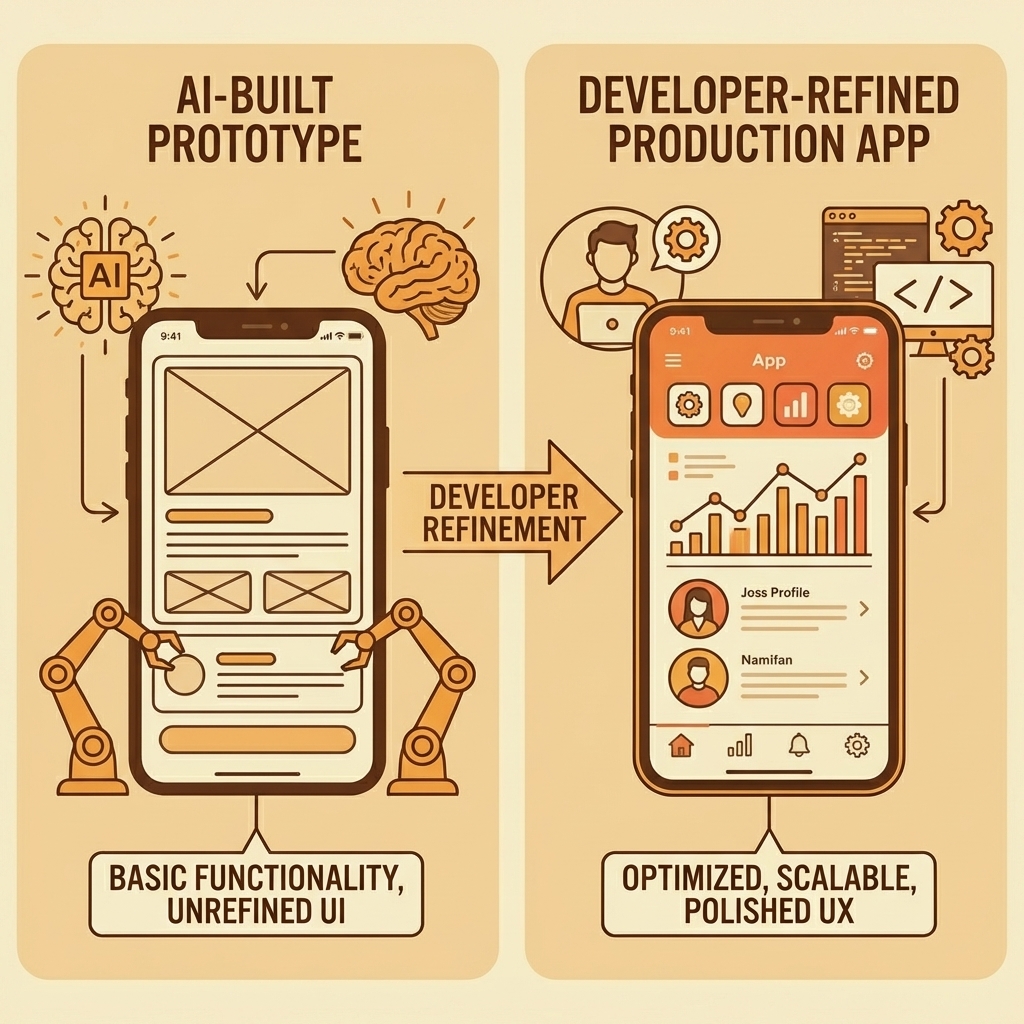
AI tools let you build prototypes fast, but turning that prototype into something you can actually use requires developer judgment. You can start building today with conversational interfaces that handle boilerplate, database setup, and deployment infrastructure. The real test comes with authentication that scales, payment flows that handle edge cases, or integrations that survive API changes—where human expertise transforms a working demo into a production-ready application.
Key Point: AI excels at rapid prototyping, but production deployment requires experienced developer oversight to handle real-world complexity.
Tip: Start with AI-generated prototypes to validate your concept quickly, then bring in developer expertise for scaling, security, and maintenance considerations.
"The gap between a working prototype and production-ready software is where developer experience becomes invaluable—handling edge cases, security vulnerabilities, and performance optimization that AI tools often miss." — Software Development Best Practices
| AI Prototype Stage | Production Requirements | Developer Value |
|---|---|---|
| Basic functionality | Scalable architecture | System design expertise |
| Demo-ready features | Security implementation | Vulnerability assessment |
| Quick deployment | Performance optimization | Code review & refactoring |
Start with a small test project
Pick something narrow but real: a feedback form with email notifications, a booking system with calendar integration, or a content dashboard pulling from an API. Build it using AI-assisted tools to identify where the process feels smooth and where problems arise. You'll quickly discover which parts AI handles well (form layouts, basic CRUD operations, styling adjustments) and which require deeper thinking (error handling, data validation, security protocols).
Platforms like AI app generator let you build across any stack through chat, connect your own API keys to control costs, and deploy with one click. Our Orchids platform lets you focus on whether the solution solves your problem while the interface handles repetitive implementation work. Bring your preferred database, authentication provider, and payment processor: our tool amplifies what you know rather than replacing how you work.
Watch where AI needs guidance
AI generates code that compiles. Developers ensure it performs under load, integrates cleanly, and handles failures gracefully. Run your test project through realistic scenarios: What happens when two users submit the same form simultaneously? How does the system respond when the third-party API times out? Does the authentication token refresh before expiry, or do users get logged out mid-session? These questions reveal that strategic thinking matters more than code-generation speed.
The gap between "it works on my machine" and "it handles 10,000 concurrent users" is where experienced developers prove their value. They recognize that the database query will slow as your user base grows, spot the API integration that will break when the provider updates its response format, and build in monitoring and logging so you know when something fails. AI can suggest optimizations, but developers decide which tradeoffs align with your business priorities and technical constraints.
Start building your first app for free. Test AI-assisted workflows against real requirements. Collaboration between AI tools and skilled developers lets you tackle more ambitious problems faster, using fewer resources on non-differentiating work.
Bilal Dhouib
Head of Growth @ Orchids